
Pike Projected and Actual Release
A projected date is an estimate or computed boundary based on current sentence information. An actual release date records the event after a person leaves a particular custodian. Pennsylvania also uses minimum and maximum sentence dates. The minimum usually marks when a state prisoner can first become eligible for parole. It is not a promise of parole. The maximum is the outer sentence boundary unless another lawful order, sentence, or custody authority changes the result.
A person awaiting trial usually lacks a sentenced release date. Bail may be posted, modified, or revoked. Charges may be resolved, and another court or agency may lodge a detainer. A detainer is a request or order that can keep a person held for another authority. For that Pike County case, the UJS docket, court order, commitment calculation, and PCCF record are more useful than a state-prison formula.
Pike DOC Release Date Limits
The public PA DOC Inmate/Parolee Locator does not label an inmate field “Projected Release Date,” “Tentative Release Date,” “Minimum Date,” or “Maximum Date.” That is a crucial Pennsylvania-specific limit. The supervised-person detail can display Release Date, but this is a past release from state prison to current supervision. It must not be renamed or described as a future projected date.
The locator has two main datasets. An inmate search concerns people currently in PA DOC custody. The Department Supervised Individual Locator concerns people currently under PA DOC field supervision. A person who had a Pike County jail-only sentence may never appear. Someone who fully discharged from state supervision may also no longer be in the current-supervision data. No result does not settle the release question.
For official sentence computation, minimum, maximum, or discharge data not published in the locator, request the inmate record from PA DOC. Use the commitment and court sentence to resolve any conflict. Public search labels should be quoted as they appear, without turning a past Release Date into a projected one.
Search Pike State Release Records
The PA DOC search form is still useful for confirming whether a named person is in current state custody or current state supervision, even though it lacks a public projected field.
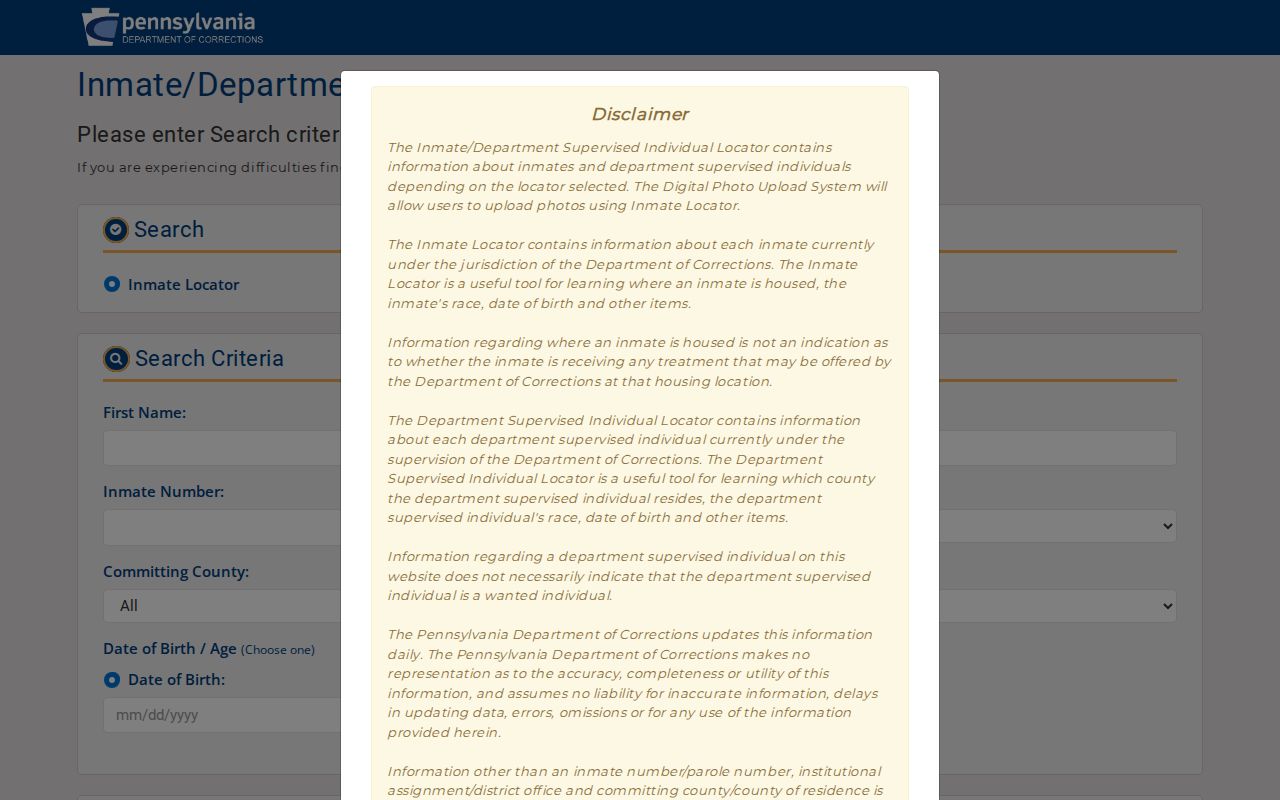
The captured form shows the public name and number inputs. It provides a starting point for state identity and status, while the official record request supplies unpublished sentence dates.
Find Pike Projected Release Records
Begin with custody type. Pike County Correctional Facility, PA DOC, BOP, and ICE are separate authorities. A release from one may be a transfer to another. The court docket can show the legal event behind custody, but it does not establish the exact moment a person walked out of a facility.
- Identify whether the person is pretrial, serving a Pike County sentence, serving a state sentence, or held for another authority.
- Review the UJS criminal docket for bail, sentencing, later orders, and the committing court.
- For a county sentence, ask PCCF, Pike Adult Probation, and the Clerk of Courts for the commitment, credit calculation, parole order, and release entry.
- For a state sentence, search PA DOC, then request the official inmate record for minimum, maximum, RRRI, and discharge calculations.
- Check for detainers, consecutive cases, Board action, or other agency custody before treating any date as final.
The Pike County released inmates search provides the full cross-agency route when the current custodian is uncertain. A narrow date question can become a custody-chain question when a transfer or hold is involved.
Pike State Sentence Boundaries
Under 42 Pa.C.S. § 9756, a court imposing total confinement generally sets a maximum and a minimum that does not exceed one-half of the maximum, subject to other statutory rules. PA DOC calculates sentence dates from the commitment materials and applicable credits. Errors or changes in those source records can change the calculation.
Under 61 Pa.C.S. § 6137, the Pennsylvania Parole Board generally cannot parole a person before the court-fixed minimum. The official Pennsylvania parole-process explanation states that the minimum means eligibility, not guaranteed release. Parole is conditional release after the minimum and before the maximum, with the sentence balance served under community supervision.
A Board grant may still require an approved plan, address, program, detainer resolution, or other prerequisite. Physical release is not confirmed until PA DOC records it. A review month is also not a door-out date, and a minimum date is not automatically a hearing appointment.
No Pike 85 Percent Rule
Pennsylvania expressly rejects the generic claim that every inmate must serve 85 percent of the maximum before parole. There is no valid statewide shortcut that multiplies a Pike or PA sentence by .85. Such a calculation ignores the court-fixed minimum, sentence structure, eligibility rules, credits, detainers, and Parole Board authority.
The correct state framework begins with the sentence imposed by the court. PA DOC computes the minimum and maximum for a state commitment. The minimum marks ordinary parole eligibility, while the Board retains the release decision. Any RRRI minimum must come from the statute and actual certification, not from the 85 percent myth.
This Section 19 distinction is especially important when online calculators present one date without the commitment record. A neat estimate can still be wrong. Use the court order and responsible agency's computation.
Pike RRRI Release Calculations
Pennsylvania's principal supported sentence-reduction mechanism here is the Recidivism Risk Reduction Incentive, or RRRI. It is not ordinary day-for-day good time for every prisoner. RRRI applies only to eligible, court-designated people who are later certified by PA DOC after meeting program, conduct, and correctional-plan requirements. The Parole Board still decides release.
Under 61 Pa.C.S. § 4505, an eligible RRRI minimum is three-fourths of the regular minimum when that minimum is three years or less. It is five-sixths when the regular minimum exceeds three years. Partial days round to the nearest whole day. Sentence aggregation rules also apply, and an ineligible part of an aggregated sentence can make the aggregate ineligible.
Eligibility and exclusions appear in § 4503. They must be checked case by case. The PA DOC RRRI page describes a positive-adjustment review using the prior 12 months in DOC, including misconduct history, institutional evaluations, program status, and correctional-plan compliance. Time in county custody does not count toward that DOC adjustment.
- Regular minimum
- The court-based minimum used for ordinary parole eligibility.
- RRRI minimum
- A shorter statutory minimum for an eligible and certified person.
- Aggregation
- Combining sentence terms for calculation under governing rules.
- Certification
- PA DOC's determination that program and conduct criteria have been met.
Pike Short Sentence Parole
Short Sentence Parole under 61 Pa.C.S. § 6137.1 may apply to eligible PA DOC commitments with an aggregate regular or RRRI minimum of two years or less. Extensive exclusions apply. Section 6137.2 provides reentry-supervision rules for certain longer commitments. Neither law creates a public projected-date field in the PA DOC locator.
Program labels should not be inferred from sentence length alone. The actual commitment, eligibility review, certification, and agency action control. A person may be excluded by facts not visible in a basic public search. Request the official record before stating that a specialized release track applies.
Note: Eligibility for a sentence program is not the same as approval, completed prerequisites, or recorded physical release.
Pike Release Dates Can Change
Sentence dates can move when the facts or controlling records change. Some events change the computation itself. Others block or delay physical release even when a date remains on a record. The distinction helps explain why two official documents can refer to different milestones.
| Factor | Possible effect | Record to check |
|---|---|---|
| Credit for time served | Changes the calculated sentence balance | Commitment and DOC or county credit calculation |
| Consecutive or concurrent terms | Changes how multiple sentences combine | Sentencing orders and aggregation record |
| RRRI eligibility or certification | May create or remove an earlier minimum | Court designation and PA DOC record |
| Parole grant, refusal, or rescission | Controls conditional release after eligibility | Latest PB-361 Board Action |
| Detainer or transfer order | May send the person to another custodian | Facility release entry and receiving-agency record |
| Misconduct or program status | Can affect a legally relevant adjustment or readiness | PA DOC institutional and RRRI records |
| Revocation or recommitment | Can add custody and require recalculation | Board action and recalculation decision |
Appellate orders, corrected sentencing orders, and clerical corrections can also change dates. Always use the newest controlling record. A date copied before the update may remain online or in an older document after the official calculation changes.
Pike County Sentence Dates
Do not apply PA DOC RRRI formulas automatically to a Pike County jail sentence. Local court parole and county commitment calculations follow the Pike sentencing order and the law that applies to that sentence. The county research found no official PCCF good-time calculator or weekend-release rule. Neither should be invented.
For a county sentence, request the sentencing order and any later amendment from the Clerk of Courts. Ask PCCF for the commitment or release record and the calculation it can lawfully provide. Pike Adult Probation can explain the public confirmation path when the Court releases a person on county parole. These records answer different parts of the question and should be reconciled.
A PCCF departure entry may show release to the community, county supervision, PA DOC, another county, USMS, or ICE. If the destination is another authority, the date marks release from PCCF only. It does not mean freedom from all custody.
Confirm Pike Actual Release
After finding the best available sentence date, monitor the responsible agency rather than treating the estimate as final. Pennsylvania SAVIN and VINELink can send a custody-change notice for participating county jail, state prison, and state parole records. Registration and limits are detailed on the Pike County VINELink check. VINE does not cover BOP or ICE.
For a state case, compare the latest Board Action, official inmate record, and the locator's eventual supervised-person Release Date. For a county case, compare the court order, PCCF entry, and local supervision confirmation. The release event may happen later than an eligibility date, or the person may leave one facility through transfer rather than community release.
Final verification is simple in principle: identify the legal milestone, identify the custodian, and obtain that custodian's actual release or transfer record. That sequence prevents a minimum, review date, projected estimate, or alert from being overstated.